
Whether you’re building your dream home or planning a kitchen renovation, here’s how to maximize your Parade of Homes experience
The Manitoba Home Builders’ Association Spring Parade of Homes is more than just a chance to peek inside beautiful houses—it’s an invaluable educational opportunity, a design discovery experience, and a chance to see the latest trends and innovations in home building and renovation. With 119 homes showcased across 22 neighbourhoods this year (February 28 – March 22), you’ll want to make every tour count.
Whether you’re planning to build a new home in the next year or you’re finally ready to tackle that kitchen renovation you’ve been dreaming about, here’s your complete guide to getting the most value from your Parade experience.
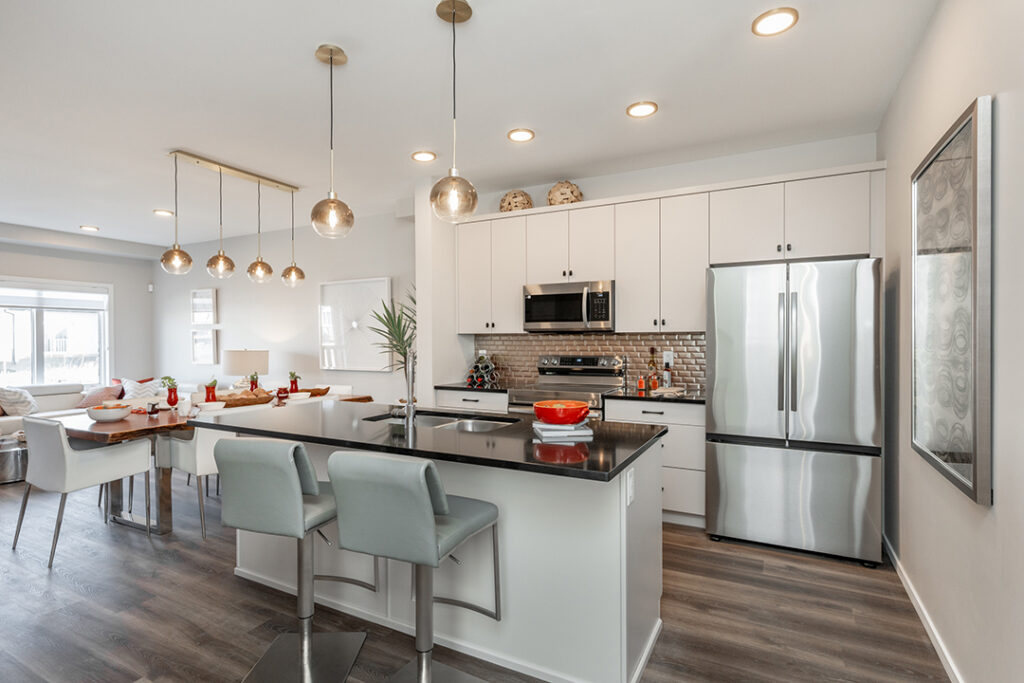
Before You Go: Smart Planning Makes All the Difference
1. Define Your Goals
Before you step foot in your first show home, take 30 minutes to clarify exactly what you’re hoping to accomplish. Your goals will shape your entire Parade strategy.
For New Home Buyers: – What’s your realistic budget range? – Which neighborhoods interest you most? – What home style speaks to you? (Contemporary, traditional, transitional) – What’s your must-have list vs. nice-to-have list? – What size home do you need? (Square footage, bedrooms, bathrooms)
For Renovators: – Which rooms are you planning to update? – What’s your renovation budget? – What frustrates you about your current space? – What do you love that you want to keep? – What’s your timeline?
Write these down. Keep them in your phone. They’ll help you focus during overwhelming moments when you’re touring your tenth gorgeous kitchen and everything starts to blur together.
2. Do Your Homework
Visit the official Parade of Homes website before you go. https://www.homebuilders.mb.ca/parade-of-homes/
3. Create Your Touring Route
With over 100 homes to see, you can’t visit them all—at least not in one day. Create a strategic touring plan:
Start with your top neighborhood choices. If you’re building, focus on communities where you’re actually considering purchasing. If renovating, pick neighborhoods with homes similar in age and style to yours.
Cluster your tours geographically. Group homes by area to minimize drive time. Most Parade maps are organized by neighborhood, making this easy.
Plan for 20-30 minutes per home. Yes, really. You’ll want time to: – Walk through thoughtfully (not rushed) – Take photos – Ask questions – Chat with the builder representative – Make notes
Budget your energy. Most people can actively engage with 4-6 homes before decision fatigue sets in. After that, you’re just walking through in a daze. It’s better to see fewer homes thoroughly than to rush through many superficially.
4. Assemble Your Touring Toolkit
Essential Items to Bring:
📱 Charged smartphone with extra battery pack – You’ll be taking dozens of photos and using the GPS constantly
📏 Measuring tape – When you see a kitchen island you love, measure it. When you fall for a vanity, measure it. Measure everything. You’ll thank yourself later when you’re trying to figure out if something similar will fit in your space.
📓 Small notebook and pen – Yes, your phone has notes, but there’s something about physically writing down measurements and observations that helps them stick. Plus, battery life.
🗂️ Folder or envelope – For collecting builder business cards, brochures, and product information
👟 Comfortable shoes – You’ll be walking and standing for hours. This is not the day for new shoes or fashion over function.
🧥 Layers – You’ll be going in and out of homes, cars, and potentially cold weather. Dress in layers you can easily adjust.
💧 Water bottle and snacks – Stay hydrated and energized. Parade touring is more physically demanding than you think.
Optional but Helpful:
📋 Printed checklist of homes you want to see (backup for phone)
🕶️ Sunglasses (you’ll be driving between homes)
📷 Actual camera if you’re a photography enthusiast
👥 A trusted friend/family member (but keep your group small—more on this later)
5. Know the Hours and Plan Accordingly
Winnipeg & Surrounding Area: – Monday – Thursday: 4:00 PM – 8:00 PM – Saturday & Sunday: 12:00 PM – 5:00 PM
Brandon: – Tuesday & Thursday: 5:00 PM – 8:00 PM – Saturday & Sunday: 12:00 PM – 5:00 PM
Strategic timing tips:
Weeknight evenings (Monday-Thursday, 5-7 PM) tend to be less crowded than weekends. You’ll have more space to explore, longer to chat with builder representatives, and better photo opportunities without people in the background.
Opening weekend (February 28 – March 1) will be busy but exciting. The energy is high, and builders are fully staffed and enthusiastic.
Final weekend (March 21-22) is your last chance. Go early on Saturday if you haven’t toured yet—procrastinators will create Sunday afternoon crowds.
Mid-Parade weekdays (first two weeks of March, Mon-Thurs) are often the sweet spot—homes are still fresh, representatives are experienced after answering questions for days, and crowds are manageable.
What to Look For: A Room-by-Room Guide
Kitchens: The Heart of Every Home
Since you’re reading this on a cabinetry company’s website, let’s start where Kitchen Craft Cabinetry is most passionate: kitchens. Kitchens are also consistently the most important room in any home tour.
Cabinet Quality Indicators:
Construction: Open and close several doors and drawers. Quality cabinets feature: – Soft-close mechanisms (doors and drawers shouldn’t slam) – Dovetail drawer joints (look inside the drawers) – Solid wood or high-quality plywood—not particleboard – Full-extension drawer glides (pull the drawer all the way out) – Adjustable shelves inside cabinets
Finish Quality: Run your hand across the cabinet surface. It should be smooth, with consistent color throughout. Look inside cabinets too—quality finishes are complete, not just on visible surfaces.
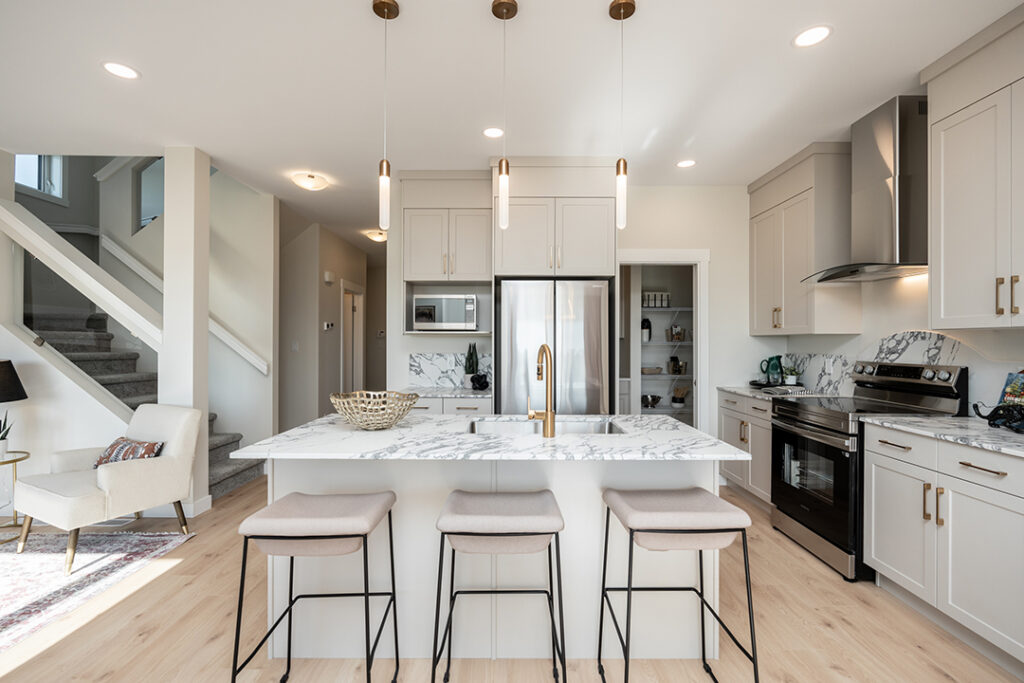
👀 WHAT TO LOOK FOR IN THIS HOME: – Consistent cabinet finish quality (note the flawless white) – Quality hardware that feels substantial (gold pulls shown) – Professional installation with precise alignment – Integrated storage solutions – Marble-look countertops with coordinating backsplash – Under-cabinet and pendant lighting layering
Hardware: Is it just decorative, or does it feel substantial? Quality hardware feels solid and operates smoothly.
Details that Reveal Quality: – Face frames that are aligned properly – Door gaps that are consistent – Crown molding that meets cleanly at corners – No visible fasteners or rough edges.
Storage & Organization Solutions:
Pay special attention to clever storage solutions you might not have considered:
- Pull-out spice racks
- Deep drawer organizers
- Corner cabinet solutions (lazy susans, pull-out units)
- Appliance garages
- Charging station drawers
- Tray dividers
- Pot and pan organizers
- Trash/recycling pull-outs
Take photos of anything that solves a problem you currently have.
Layouts That Work:
Notice how the kitchen functions: – Is the work triangle efficient? (sink, stove, refrigerator) – Is there enough counter space on both sides of the cooktop? – Where would you prep vegetables? Where would you serve food? – How many people could cook together comfortably? – Does the island positioning make sense, or would it create traffic jams?
Islands: Size, Style, and Function:
Islands have become kitchen centerpieces. Measure any island that appeals to you—people almost always overestimate how large an island will fit in their space.
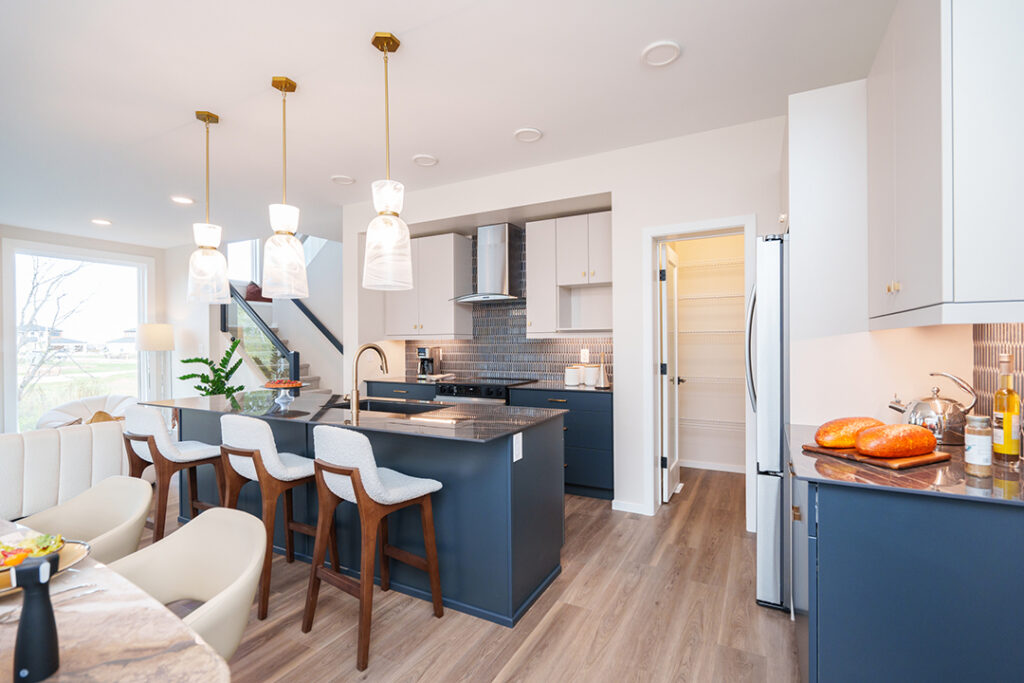
👀 ISLAND DESIGN ESSENTIALS (Visible Here): – Seating for 3 with proper 12-15” overhang for comfortable leg room – Contrasting navy island color creates visual drama and focal point – Gold pendant lighting positioned at proper height (30-36” above counter) – Storage underneath with drawer configuration for organization – Island positioned to maintain efficient work triangle with stove and fridge – Walk-in pantry door visible on left (another major storage trend).
Note these island features: – Seating configuration (how many people? On which sides?) – Counter overhang for seating (should be 12-15 inches) – Storage underneath (cabinets, drawers, open shelving?) – Electrical outlets (how many? where placed?) – Plumbing (sink? dishwasher? wine fridge?).
The Two-Tone Cabinet Trend:
A kitchen design trend you’ll see throughout the 2026 Parade is two-tone cabinetry—contrasting colors between upper cabinets, lower cabinets, and islands. This approach adds visual interest and helps define spaces in open-concept layouts.
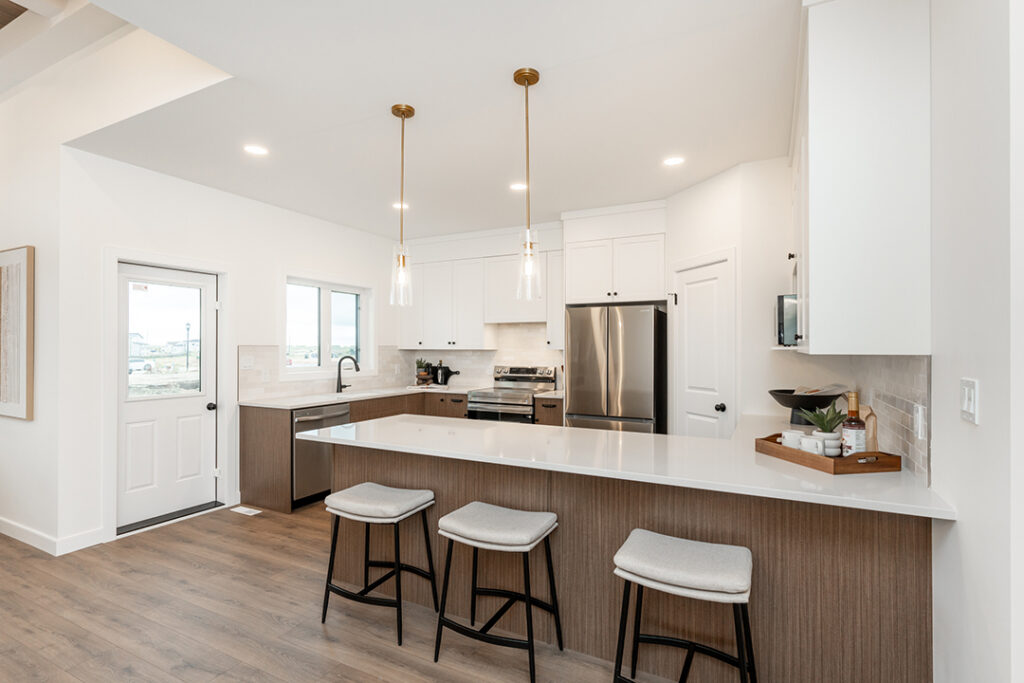
Popular Two-Tone Combinations You’ll See: – White uppers + wood-tone lowers (shown here) – White perimeter + colored island (navy, forest green, charcoal) – Light neutrals + dark contrasts – Painted + stained wood combinations.
When considering two-tone for your own space: Make sure both colors work with your countertops, backsplash, and flooring. What looks cohesive in a show home might clash with your existing elements.
Specialized Spaces:
Spice kitchens/Butler’s pantries are trending. These are separate prep areas, typically tucked away from the main kitchen, for: – Extra appliances (second sink, extra fridge, coffee station) – Food prep that you don’t want visible – Storage for small appliances you use but don’t want on counters – Serving buffet space during entertaining. If you see one, photograph it from multiple angles. These spaces can be retrofitted into many existing homes during renovations.
Pantries come in many styles now: – Walk-in pantries – Butler’s pantries – Pull-out pantry cabinets – Corner pantry units – Floor-to-ceiling pantry walls. Note which style would work in your space.
Bathrooms: Small Spaces, Big Impact
Vanities and Storage:
Bathroom cabinetry faces unique challenges—humidity, smaller spaces, different storage needs. Look for: – Water-resistant finishes – Smart storage solutions (drawer organizers, pull-out hampers) – Adequate clearance around doors and drawers – Lighting that doesn’t create shadows on faces.
Space Planning:
If you’re renovating a bathroom, pay particular attention to the spacing between fixtures. Building codes dictate minimums, but comfortable bathrooms exceed them: – At least 30” clear space in front of toilet and vanity – At least 60” of turning radius for wheelchairs (important for aging in place) – Shower/tub placement that doesn’t create awkward entry.
Living Areas: Flow and Function
Open Concept Realities:
Open concept floor plans look amazing in show homes. Ask yourself: – Where would your TV go? – Where would the kids do homework if parents are entertaining? – Would cooking smells permeate the entire main floor? – Is there enough wall space for your furniture? – Will you miss the coziness of defined rooms?
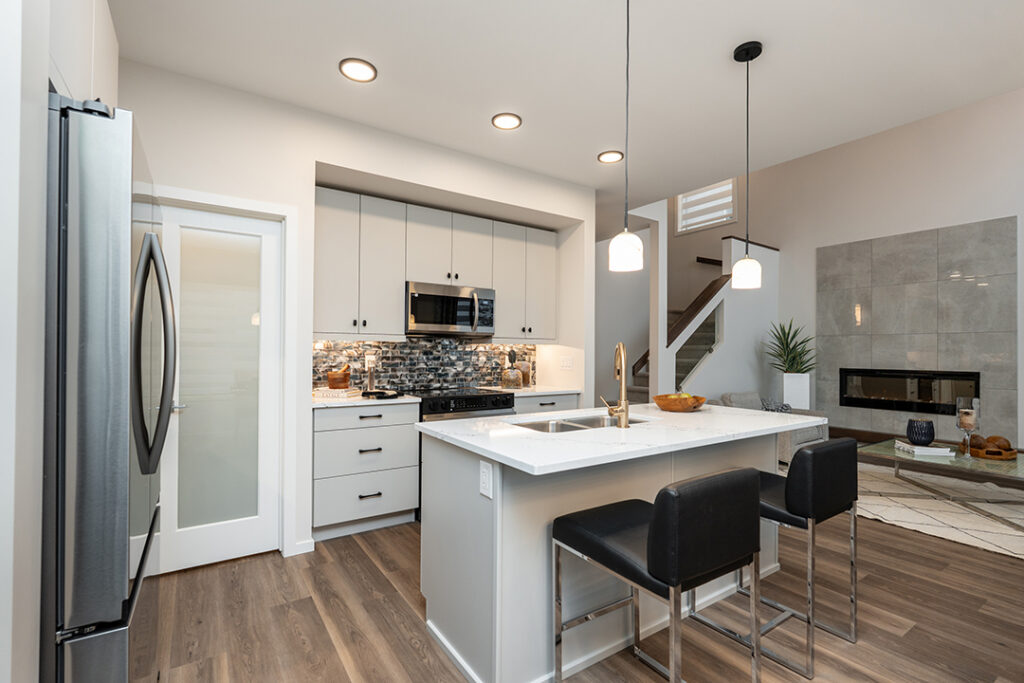
Ceiling Heights and Features:
Standard ceilings are 9 feet. Vaulted, tray, and coffered ceilings can add drama but also cost. Notice what impact they have on the feel of different rooms.
Practical Considerations Often Overlooked
Storage Throughout:
- Coat closet near the entry
- Linen closet in the bathroom hallway
- Garage organization systems
- Laundry room cabinets
- Basement storage solutions
Lighting:
Show homes are professionally lit. Notice the layering: – Ambient lighting (general illumination) – Task lighting (over work areas) – Accent lighting (highlighting features) – Natural light (window placement and size).
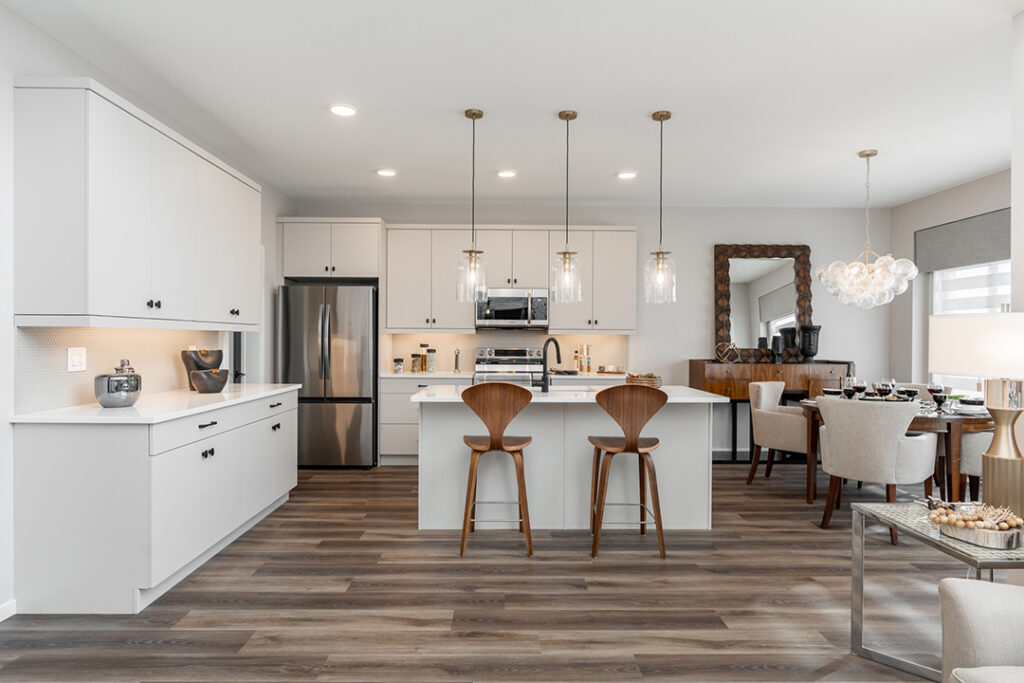
What Professional Lighting Looks Like: – Multiple light sources at different levels – Task lighting over work areas (island, cooktop, sink) – Ambient lighting for overall illumination (recessed ceiling lights) – Accent lighting for drama (pendants, under-cabinet) – Natural light maximized through window placement – Dimmers for mood and function control.
Electrical Outlets:
Count them. Are there enough? Are they in convenient locations? This is especially important in kitchens and home offices.
Engaging with Builder Representatives
Every show home will have a builder representative on-site. These people are valuable resources—use them!
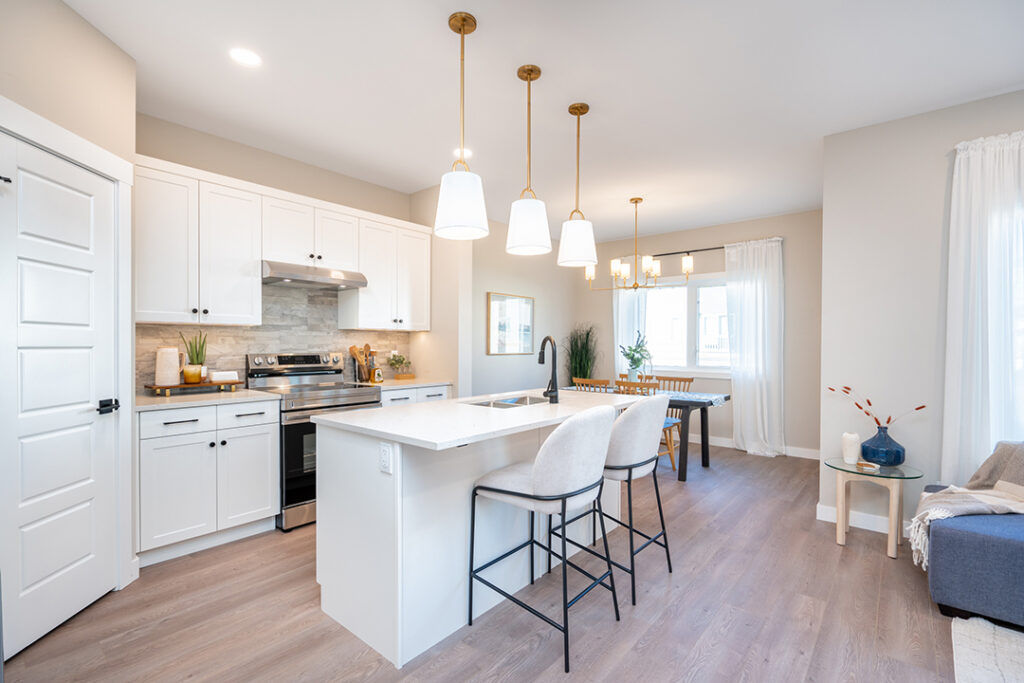
Why All-White Endures: – Bright and space-enhancing (especially valuable in smaller kitchens) – Timeless—won’t feel dated in 10 years – Versatile—works with any accent color or décor change – Clean aesthetic that appeals to most buyers (important for resale) – Pairs beautifully with natural wood tones (flooring, furniture).
Special Considerations for Renovators
Translating Show Home Features to Existing Homes
Show homes are designed from scratch. Your home has existing constraints: – Load-bearing walls – Plumbing locations – Electrical panels – HVAC ductwork – Window and door locations – Uneven floors or walls.
When you see something you love, ask yourself: – Could this work with my current layout? – Would I need to move plumbing? – Would structural changes be required? – Does my ceiling height support this?
Take photos of features that could work AS-IS in your space. These are your best bets for achievable renovations.
Finding Your Style Within Your Home’s Character
A 1960s bungalow and a 2020s transitional have different design languages. You can update a dated home beautifully, but fighting its architectural era is expensive and often unsuccessful.
Instead of fighting your home’s style: – Look for Parade homes from the same era – Choose updated versions of period-appropriate details – Focus on quality materials in appropriate styles. For example: If you have a 1980s home with oak cabinets, don’t fight the wood—embrace updated wood tones (walnut, natural oak, stained maple) rather than forcing an all-white contemporary look.
Featured Homes: Plan Your Visit
All seven kitchens photographed in this guide feature Kitchen Craft Cabinetry and demonstrate various design approaches. Here’s where to find them:
Hilton Homes (@hiltonhomeswpg)
- 19 Bass Bay – Prairie Pointe | Contemporary open concept with black counters
- 115 Mill Rock – Highland Pointe | Modern with statement fireplace and mixed materials
- 296 Masters – River Springs Grove | Dramatic two-tone (white/navy) with walk-in pantry
- 301 Granite Grove – Prairie Pointe | Clean contemporary with organized storage
Daytona Homes (@daytonahomeswinnipeg)
- 129 Mill Rock – Highland Pointe | Two-tone with wood textures and gold accents
- 7 Adara Alley – Aurora at North Point | Classic all-white with traditional styling
- 14 Ken Butchart – Devonshire Park | Elegant with marble accents and open shelving
Final Thoughts: Making Your Parade Experience Count
The Manitoba Parade of Homes is a unique opportunity—Canada’s largest showcase of new home construction and design innovation. Enjoy it! There’s something magical about walking through beautiful homes and imagining possibilities. Savor that inspiration—it’s the fuel that will carry you through your own building or renovation journey.
Your Next Steps
Ready to turn your Parade inspiration into reality?
If you’re planning a kitchen renovation or building new:
Kitchen Craft has cabinetry featured in 40-50 homes throughout the 2026 Spring Parade—giving you the chance to see our quality, versatility, and style range firsthand. The seven kitchens featured in this guide are just the beginning. We’ve been helping Manitobans create their dream kitchens for decades, working with the province’s top builders like Hilton Homes and Daytona Homes.
Schedule a free design consultation at our Winnipeg and Regina showrooms. Our experienced designers will help you translate your Parade inspiration into a kitchen that works for your space, lifestyle, and budget.
📅 Book Your Consultation | 🗺️ Find KitchenCraft Homes | 📞 Contact Us
The Manitoba Spring Parade of Homes runs February 28 – March 22, 2026. For official event information, visit homebuilders.mb.ca. Kitchen Craft is a proud partner of Manitoba’s top home builders and your local choice for quality custom cabinetry.
Special thanks to Hilton Homes (@hiltonhomeswpg) and Daytona Homes (@daytonahomeswinnipeg) for providing the stunning photography featured throughout this guide.
The Kitchen Craft design team has decades of combined experience helping Manitobans create beautiful, functional kitchens. We’ve worked with hundreds of Manitoba Parade of Homes builders and understand what makes a kitchen both stunning and livable. Our Winnipeg showrooms welcome thousands of visitors each year, and we’re passionate about helping you make informed decisions for your home investment.